
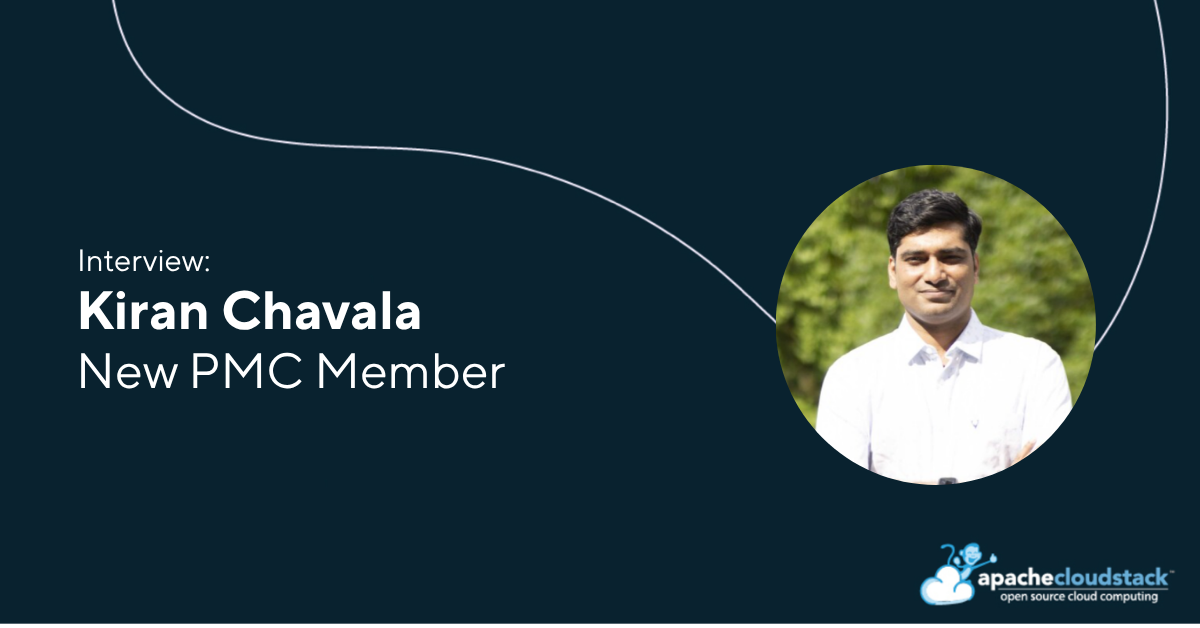
Kiran Chavala is the newest PMC member of the Apache CloudStack Project. As a QA Engineer at ShapeBlue, Kiran brings over a decade of experience in cloud and IaaS technologies, along with a strong track record of contributions across testing, feature validation, observability, and community support.
In this interview, Kiran shares his journey with Apache CloudStack, his perspective on the value of open-source collaboration, and the projects he’s been working on — from Terraform plugin releases to Kubernetes integration and monitoring tools. He also discusses how global community collaboration drives innovation and outlines his vision for the future of CloudStack, including sovereign cloud initiatives, AI-ready infrastructure, and continued growth driven by flexibility and vendor independence.
Introduce yourself in a few words and what your job role/company is?
I’m Kiran Chavala, a QA Engineer at ShapeBlue with over a decade of experience in cloud and IaaS technologies. I work extensively with Apache CloudStack, where my role involves testing new features, identifying bugs and security-related issues, and ensuring overall product quality before releases. I also contribute to improving user experience, documentation, and tooling within the CloudStack ecosystem, while actively supporting users and community members.
What do you think are the benefits of utilising open-source projects, like CloudStack?
Open-source projects like Apache CloudStack provide unmatched flexibility, transparency, and innovation. Organisations can avoid vendor lock-in and tailor solutions to their specific needs while benefiting from a globally distributed community of contributors continuously improving the platform.
From my experience, open-source fosters faster innovation cycles—features evolve through real-world feedback, and issues are quickly identified and resolved. It also creates opportunities for collaboration across organisations, enabling knowledge sharing and building highly scalable, production-grade cloud environments without licensing constraints.
How do you collaborate with the community distributed around the world?
Collaboration in open source is inherently global, and I engage with the CloudStack community through multiple channels. This includes participating in mailing list requests, contributing to GitHub pull requests, and helping users troubleshoot issues.
I also share knowledge through blogs, talks, and documentation, which helps onboard new users and contributors. Being part of a distributed community means working asynchronously, respecting different time zones, and communicating clearly through well-documented discussions and code contributions. This collaborative model ensures that ideas and improvements come from diverse perspectives.
What are some key projects and developments you have worked on and are currently working on?
I’ve contributed to Apache CloudStack across several areas, including UI improvements, API validation, and feature validation. My work involves raising issues and discussions in the CloudStack Community.
I’m also actively working with the CloudStack Plugin and tooling ecosystem, including:
- Served as Release Manager for the Terraform plugin of CloudStack
- Observability using Prometheus and Grafana
- Kubernetes integration with CloudStack
- Monitoring and benchmarking tools for cloud environments
Additionally, I regularly experiment with new open-source technologies and share my learnings through blogs and community discussions.
How do you think the CloudStack project will continue to grow over the next five years?
Apache CloudStack is well-positioned for steady, meaningful growth over the next five years, especially as organisations increasingly prioritise control, compliance, and flexibility in their infrastructure.
One of the biggest drivers will be the rise of sovereign cloud initiatives, in which governments and enterprises seek full ownership of their data, infrastructure, and security posture. CloudStack’s open-source nature, combined with its mature multi-tenancy and networking capabilities, makes it an ideal platform for building sovereign and regionally compliant cloud environments without relying on hyperscalers.
Vendor lock-in becomes critical. CloudStack’s open-source model enables organisations to retain complete control over their stack, choose their own hardware and integrations, and build cloud environments that align with regional and regulatory requirements—without being tied to a single vendor ecosystem.
Another important area is AI and data-intensive workloads. The infrastructure requirements for AI/ML—such as GPU orchestration, scalable storage, and high-performance networking—align well with CloudStack’s strengths. With continued enhancements around GPU support, automation, and integration, CloudStack can serve as a strong foundation for private AI clouds and research environments.